🔍
Oversight They Won't Let You Verify
In March 2026, OKCPD admitted in writing it had no access controls, no use policy, no audit procedures, and no discipline standards for Flock. Only after residents filled council chambers and filed records requests did the department start advertising a 30-day manual review plus a "continuous AI audit," the AI audit being Flock's own software auditing Flock's own system. Then a resident asked for the log that would prove it works, and the city denied it. Their only published ALPR policy (Manual §5-118) still covers vehicle-mounted readers, not Flock's static cameras. An audit no one is allowed to inspect is a press release, not oversight.
🚨
Breaks Oklahoma Law and OKCPD's Own Rules
Oklahoma statute 47 O.S. §7-606.1 limits ALPR use to insurance enforcement. OKCPD uses Flock far beyond that. Their own Operations Manual states ALPR data "will not be shared as part of a law enforcement information database" - but Flock's entire business model is exactly that: 5,000+ agencies and 100,000+ cameras sharing data nationwide. On August 18, OKCPD confirmed 109 local agencies can already pull OKC's Flock data, and when Councilwoman Hamon asked for the list, Chief Bacy said, "No, ma'am."
🌐
Your Data Leaves OKC - and It's Not Secure
Every photo from every camera leaves city limits and lands on Flock's private servers, beyond the reach of any public records request. The devices have numerous confirmed security vulnerabilities and can be compromised in 30 seconds. Independent researchers found at least 60 cameras streaming live to the open internet - including one pointed at a children's playground. No password. No encryption. Anyone with a search engine could watch.
📹
It's Not Just Plates Anymore
Flock's newer Condor cameras use AI-powered pan, tilt, and zoom to automatically follow people - not vehicles. The contract says 90 city cameras, but the community map shows 299 in the OKC metro as of September 2026, and that volunteer-built count is a floor. Private businesses, parking lots, and HOAs feed data into the same Flock network. In Dunwoody, GA, Flock employees were caught accessing cameras inside a gym, including the pool, fitness studio, and a children's gymnastics room. And the 90 is a floor, not a cap: through Fusus, the Axon-owned real-time crime center OKCPD taps, the department already pulls in private and community cameras beyond its Flock poles. Removing the Flock poles alone would not close that pipe, which is why we also refuse any replacement vendor, Axon included.
⚠️
Already Being Abused
It has already happened here. From December 2024 to April 2025, an OKCPD sergeant used police databases for personal use, surfaced by a resident's complaint and not by an audit, and drew a 3-day unpaid suspension and a year of probation. On August 18, Chief Bacy admitted the department has "had incidents with two employees." Elsewhere, officers have been charged with crimes for using Flock to stalk partners and exes. Tulsa PD logged protest-related searches. Texas deputies used it for an abortion investigation. Flock's own VP of Business Development searched a city's database 63 times without being a police officer. In San Francisco, outside agencies searched local data 1.6 million times without authorization. And when researchers reported all of this, Flock's CEO sent an email to police departments calling them "activists who want to defund the police."
📝
The Contract Is Rigged
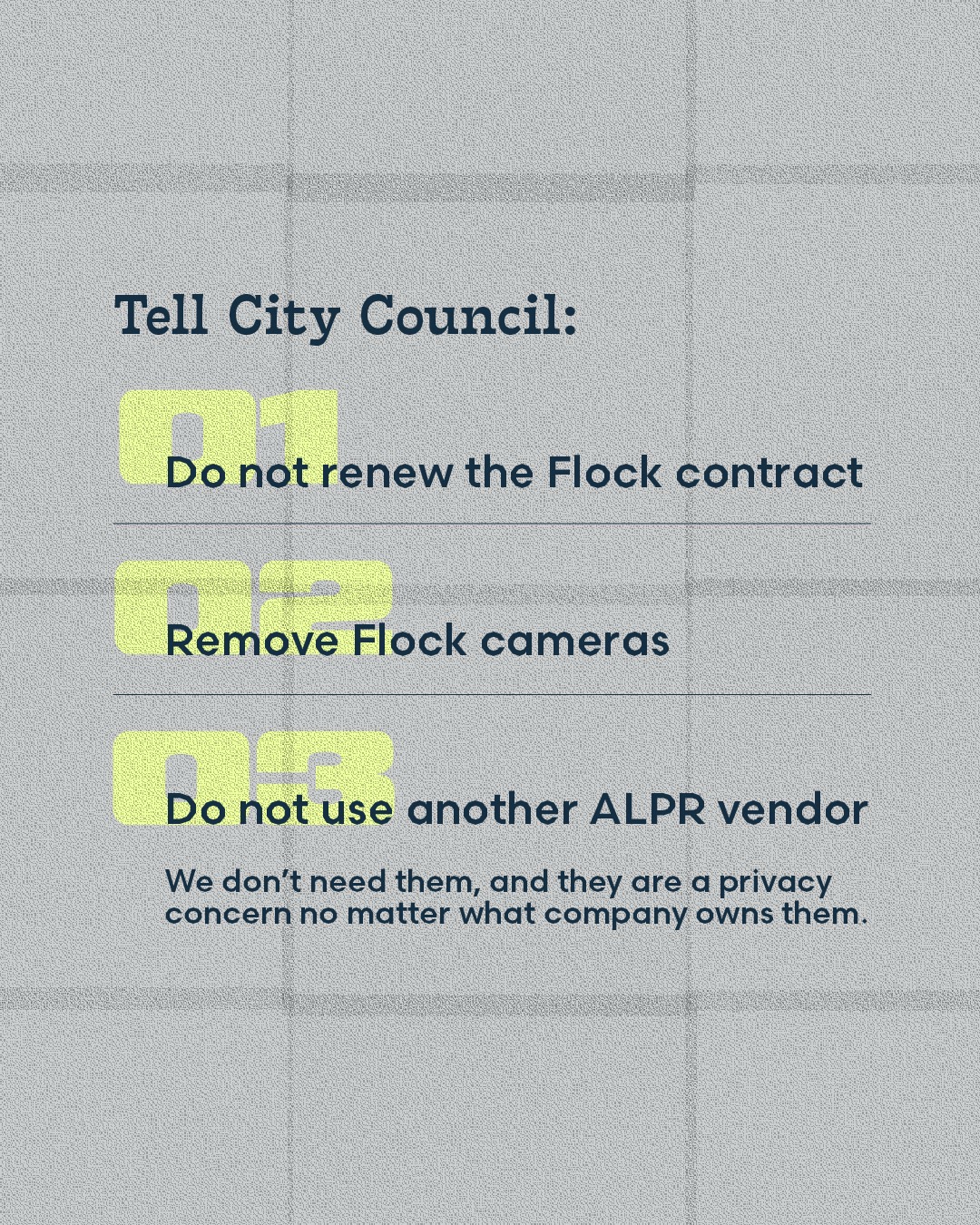
Flock can activate new surveillance features - audio detection, video, AI capabilities - on existing cameras without council approval or public notice. In February 2026, they quietly rewrote their contract terms: deleting data ownership protections and adding a "perpetual, irrevocable, worldwide" data license that survives termination. They block web archiving so cities can't track changes. The August 2026 renewal changed only one enforceable term, a ban on sharing OKC's data with federal agencies. The retention cut, the keyword blocks, and the "regular audits" the city advertised are Flock settings and department policy, revocable without a vote. See what the amendment actually changed.
📋
No Proof It Works
No effectiveness report has ever been published for OKC's system. A peer-reviewed evaluation of a major ALPR expansion in Atlantic City found no statistically significant reduction in violent crime. In San Jose, only 0.25% of 360 million captured images matched any law enforcement hotlist. The rest was just data on ordinary people going about their lives. Chief Bacy has credited Flock with roughly 1,280 stolen vehicles recovered, 210 missing persons found, and 60 murder cases aided, but the department confirmed in writing (OCPD-10088) that it keeps no records linking any Flock search to a case outcome. It cites results its own files cannot show.